
Maximize Travel Rewards with Chase Ink Business Cards: Earn Points and Transfer to Travel Partners
Affiliate Disclosure: This post may contain affiliate links, which means I may earn a small commission at no additional cost to you if you make a purchase through these links. I only recommend products and services I trust and believe will benefit you. I do not sell your personal information, and all opinions expressed in this post are my own.
Editorial Disclosure: Opinions expressed here are the author's alone, not those of any bank, credit card issuer, hotel, airline, or other entity. This content has not been reviewed, approved, or otherwise endorsed by any of the entities included within the post..


If big trips feel out of reach — international flights, multiple hotel rooms, or family vacations during school breaks — these cards are one of the most efficient ways to earn a large balance of Chase Ultimate Rewards points — even if you don’t have what you consider a traditional business.
Chase Ink Business cards are a cornerstone of my travel strategy because they earn Chase Ultimate Rewards, one of the most flexible and valuable point currencies. These points transfer 1:1 to travel partners like Hyatt, Southwest, United, and many more. With the right cards, you can leverage everyday spending into free flights and hotel stays for your family.
In this post, you’ll learn:
- Which Chase Ink Business card to start with
- Why business cards are so powerful for families
- The updated Chase Ink application rules you need to know
- How to use Ultimate Rewards for real travel (hotels + flights)
- Step-by-step examples that demystify the process
👉 Ready to see the current Chase Ink Business card offers I recommend? Start here.

Who Chase Ink Business Cards Are For
You do not need a traditional business to qualify.
If you earn any income outside a W-2 — even a few hundred dollars — you may qualify as a sole proprietor.
Examples of qualifying side hustles and activities:
- Tutoring or coaching
- Babysitting
- Selling on Facebook Marketplace or Etsy
- Photography, fitness instruction, or consulting
- Reselling items online
- Freelance work
You simply enter your name as the business owner and describe what you do. Many families I coach qualify without having “business expenses” yet — and that’s totally fine.
How the New Chase Ink Application Rules Work (Important)
Chase recently updated its application and approval rules for business cards, and it’s crucial to understand how this impacts your strategy:
1. Business Cards Do Not Count Toward 5/24
Once approved, Ink Business cards typically do not count against your personal 5/24 total. This makes them an incredibly strategic tool for earning points without blocking future personal cards.
Important nuance:
- Ink Business card approvals may still require you to be under certain limits, but once opened, they usually are not counted toward 5/24.
- Chase’s underwriting can still consider your overall credit profile, so approval is never guaranteed — but the 5/24 impact is minimized.
2. You Can Often Apply Even With Limited Business History
Unlike many business cards that require formal business documentation, Chase only asks for basic information — and your side hustle earnings often qualify you.
3. There Are Still Application Limits for Ultimate Rewards Cards
Chase has rules like:
- You can generally earn the welcome bonus on the same Chase-branded card only once every 48 months.
- Chase Sapphire cards and Ink cards may have combined application rules around earning bonuses.
The bottom line: Chase Ink cards are still one of the best opportunities for families to earn steering-wheel-worthy points balances.
Which Chase Ink Business Card Should You Start With?
You don’t need all of them at once — and starting with one will help you learn how Chase Ultimate Rewards points work before expanding.
Here are the three Ink Business cards that earn Ultimate Rewards:
Chase Ink Business Cash® Credit Card
Annual Fee: $0
Why families like it:
- No annual fee
- Great earning rates on everyday business categories
- High welcome bonus for a no-fee card
This is a common first Ink Business card — especially if you want to keep costs low but earn valuable points.
Chase Ink Business Unlimited® Credit Card
Annual Fee: $0
Why families like it:
- Simple structure — 1.5x points on every purchase
- No category tracking or planning required
- Ideal for “set it and forget it” earning
Chase Ink Business Preferred® Credit Card
Annual Fee: $95
Why families like it:
- 3x points on travel, shipping purchases, internet/cable/phone services, and online advertising — up to $150,000 per year
- Strong welcome bonus
- Best overall earning structure of the three
This card is often the end goal for many families once they’re comfortable with Chase points, because it earns more points on more spend categories and unlocks powerful transfers to travel partners.
Why Chase Ultimate Rewards Points Are So Valuable
Chase Ultimate Rewards points are valuable because:
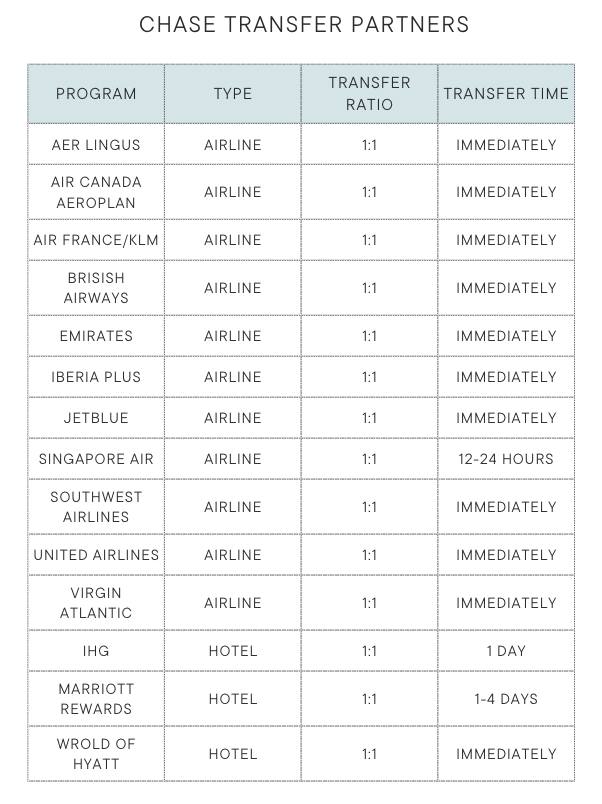
- They transfer 1:1 to 14 travel partners (airlines + hotels)
- You can combine points across cards before transfer
- Transferred points cannot be reversed (so always check availability first)
- When paired with a Sapphire card, you can redeem points through the Chase Travel Portal at a boosted value (1.25–1.5¢/pt)
This flexibility is what makes Chase Ultimate Rewards so powerful for family travel.
How to Combine and Transfer Points for Travel
Step 1: Earn Ultimate Rewards Points
Use your Ink Business card for everyday purchases — including categories like:
- Office supplies (Ink Cash)
- Travel and online services (Ink Preferred)
- Everyday expenses (Ink Unlimited)
Don’t forget: sign-up bonuses are usually where the biggest point gains come from.
Step 2: Combine Points Across Chase Accounts
If you have Ultimate Rewards points across multiple Chase cards (business or personal), you can combine them into one account before transferring:
- Log into your Chase account
- Go to the Ultimate Rewards dashboard
- Choose “Combine Points”
- Select which accounts to pull points from
This is especially useful when you want a large, consolidated balance before transfer.
Step 3: Transfer Points to Travel Partners
Once your points are combined into one account (usually your card that allows transfers), you can transfer to travel partners like:
- World of Hyatt
- United MileagePlus
- Southwest Rapid Rewards
- British Airways Avios
…among others
Transfers are usually instantaneous or near-instant, but always confirm award space before transferring points, since most transfers are irreversible.
Real Redemption Examples (Step-by-Step)
Example 1: Hyatt Hotel Stay
Goal: 3 nights at a Category 3 Hyatt hotel
Cost: ~12,000–15,000 points per night
Steps
- Earn Ultimate Rewards points
- Combine points into an Ink Preferred or Sapphire account
- Transfer to your World of Hyatt account
- Book on Hyatt.com using points
Example:
36,000 points = 3 nights at a Category 3 Hyatt
Example 2: United Flight (Economy)
Goal: One-way flight for family member
Cost: ~25,000 miles
Steps
- Transfer Ultimate Rewards to United MileagePlus
- Log into united.com
- Search award flights
- Redeem miles at checkout
Example 3: Southwest Flight
Goal: Weekend flight from Denver to Chicago
Cost: ~16,000 Rapid Rewards points (one-way)
Steps
- Transfer points to Southwest Rapid Rewards
- Search flights on Southwest.com
- Pay with points at checkout
Southwest is especially useful for families because award pricing is tied to the cash price — making planning easier.
Why I Choose Points Over Cash Back
Cash back feels simple — but it rarely gets you ahead on big travel.
Flexible Chase Ultimate Rewards points can often provide meaningfully more value for:
- Hotel stays for multiple nights
- Flights for multiple travelers
- Peak-season travel
- Larger families
Turning everyday spending into serious travel is the difference between “I wish we could go” and “We’re going next year.”
Final Thoughts
If your goal is to turn everyday spending into meaningful travel — especially for family trips — Chase Ink Business cards are one of the most reliable tools available.
You don’t need a big business.
You don’t need to travel constantly.
You just need the right starting point.
👉 To see the current Chase Ink Business card offers I recommend (and apply), click here.
If you want help deciding which card fits your situation, I break that down step by step across the blog.
Affiliate Disclosure
Some links in this post may be affiliate links. If you choose to apply through my links, I may earn a commission at no additional cost to you. I only recommend cards and strategies I personally use and trust.
Opinions expressed here are the author's alone, not those of any bank, credit card issuer, hotel, airline, or other entity. This content has not been reviewed, approved or otherwise endorsed by any of the entities included within the post.




I found out about points and miles accidentally.
I was researching index funds and happened upon the points and miles community through creators who also post about budgets, financial independence, and investing.
Points and miles allowed those people to travel and work toward financial independence simultaneously.
Thank goodness I got started when I did. The past almost two years of travel have been something we will never forget.
Earning points and miles through credit cards is only a good choice if you have the financial discipline to use them, like cash/debit cards.
Since we started traveling with points and miles, we have had more money going into our investment and savings accounts than ever.
Now I'm excited to teach you!
Welcome

I am excited you are here
New to points and miles? START HERE!

